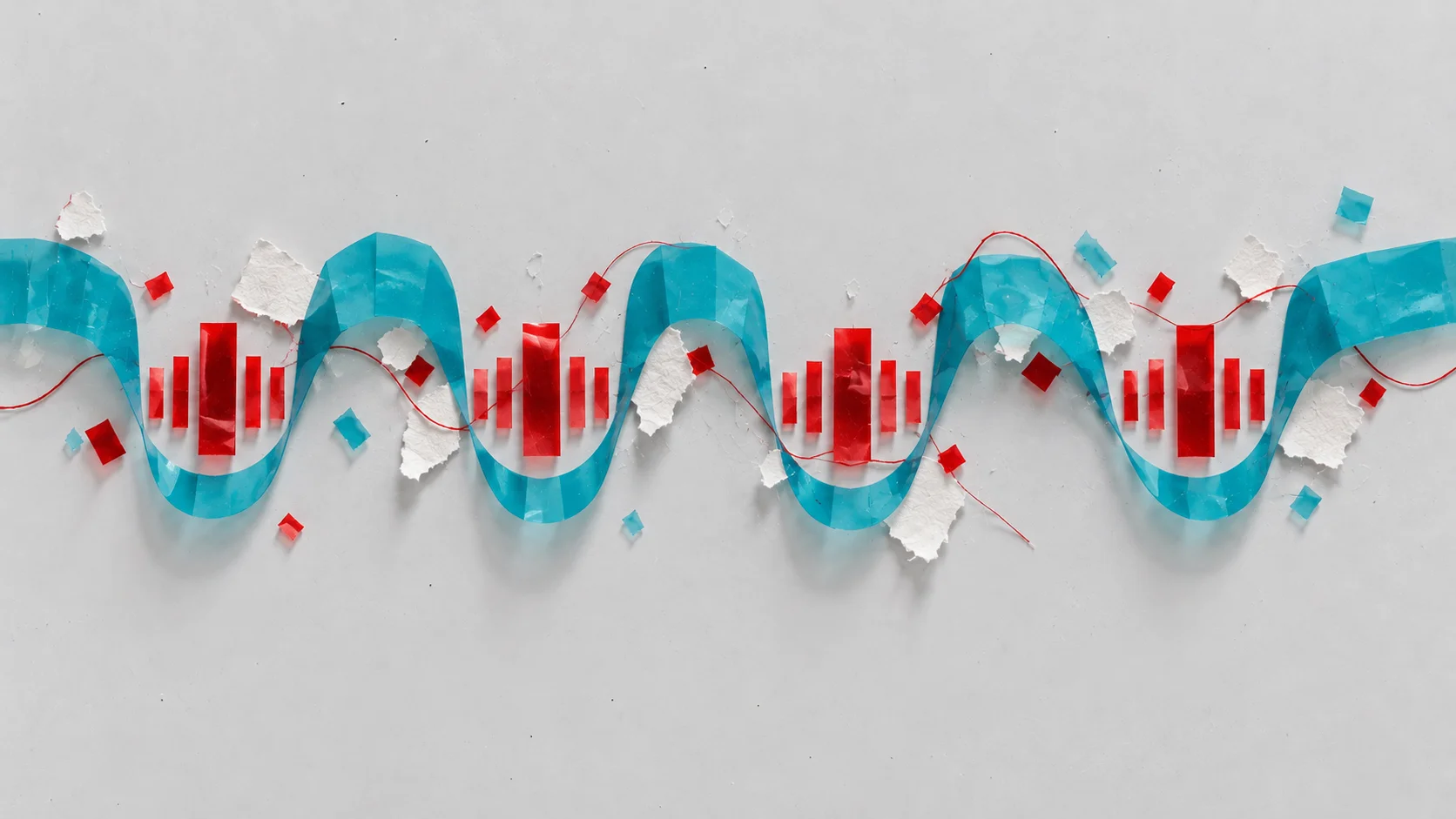
Press play below. A soft pad ducks on every beat and swells back up in between, so the whole sound seems to breathe in time. That's the sidechain pump. It started as a mixing fix (turn the bass and pads down for a split second whenever the kick hits, so the kick has room), and in the late 1990s French house producers pushed it so far that the pumping became the hook. Since then it's been all over dance music, from club tracks to pop choruses that want to feel like they're moving.
Listen to the pad come back after each dip. Does it feel like it's breathing in, or being pushed?
The finished pump
Feel
Synth Texture: Komiku, CC0 1.0
There's no kick in this example. The pad is ducking to a steady pulse on every beat, so you can hear the pump on its own; in a track, that pulse would be your kick. Before you change anything: which matters more to the feel, how deep the dip goes, or how the sound comes back?
1. Set how deep it ducks
Space sets how far the pad drops on each pulse. Turn it down low and the movement is a gentle nudge you feel more than hear, the kind mix engineers use only to clear room for the kick. Turn it up and the pad nearly vanishes on every beat. Now you can choose between a mix trick and a musical effect.
Why: Gates, sidechain and ducking explains how one sound can control the level of another.
2. Choose the pulse
Division sets how often the pulse arrives. At 1/4 the pad ducks on every beat, which is the classic four-on-the-floor pump. Try 1/8 and it flutters twice as fast; try 1/2 and it heaves slowly on beats one and three. At 120 BPM a quarter note is half a second, so at 1/4 the pad has half a second to duck and recover. Now the pump has a rhythm of its own, not only a depth.
Why: Rhythm, meter and groove turns subdivisions into intentional spacing.
3. Shape the way it comes back
This is where the feel lives. Feel changes how the pad recovers after each dip. Some choices snap back fast, which sounds tight and punchy. Others come back slowly, so the pad is still swelling when the next beat hits, which sounds lazy and hypnotic.
Same dip, different return
Try each Feel choice with the same Space and Division. Now you're choosing the groove of the pump, not only its size.
Why: Envelopes connects the shape of a curve to how a sound moves in time.
4. Use it to make room
Switch the effect off and on. With it on, imagine a kick landing in each dip: it gets a moment of clear space, then the pad fills back in behind it. That's why the pump started as a mixing trick. Even at a low Space, a pad and bass that step aside for the kick make the low end sound bigger and clearer.
Why: Low end explains why a kick and a bass fighting for the same moment sound smaller than either alone.
5. Compare fairly
Ducking makes the pad quieter on average, so the effect-on version can sound weaker only because it's softer. Use the lab's level matching when you toggle, and listen for the motion rather than the volume.
Why: Listening and comparing shows why louder almost always sounds better, and how to stop that fooling you.
Keep it
Note your Space, Division and Feel. When you start a dance track, put a ducker on the pad and bass, key it from your kick, and dial in those three numbers. It's the fastest way to make a loop feel like it's moving.
Quick check
- Your pump sounds strong but the track feels stiff. Which control do you reach for? Feel. The depth was fine; the return is too abrupt or too slow for the groove. A slower return feels lazier, a faster one tighter.
- The pad sounds weaker with the effect on. Is the pump bad? Not necessarily. It's quieter on average, and quieter sounds worse. Match levels and listen again before deciding.
- Your kick pattern has an extra hit before the snare, but your pump only ducks on the beat. What's going on? The pump is following a steady pulse, not your kick. To follow every hit, the ducker has to listen to the kick track itself. A steady pulse is fine for four-on-the-floor; a syncopated kick needs the real thing.
Next steps
- Use it: Beat from scratch. Build the kick that your pad will breathe around.
- Sideways: Compression. A ducker is a compressor that listens to a different sound than the one it's turning down.