
Code Sequencer
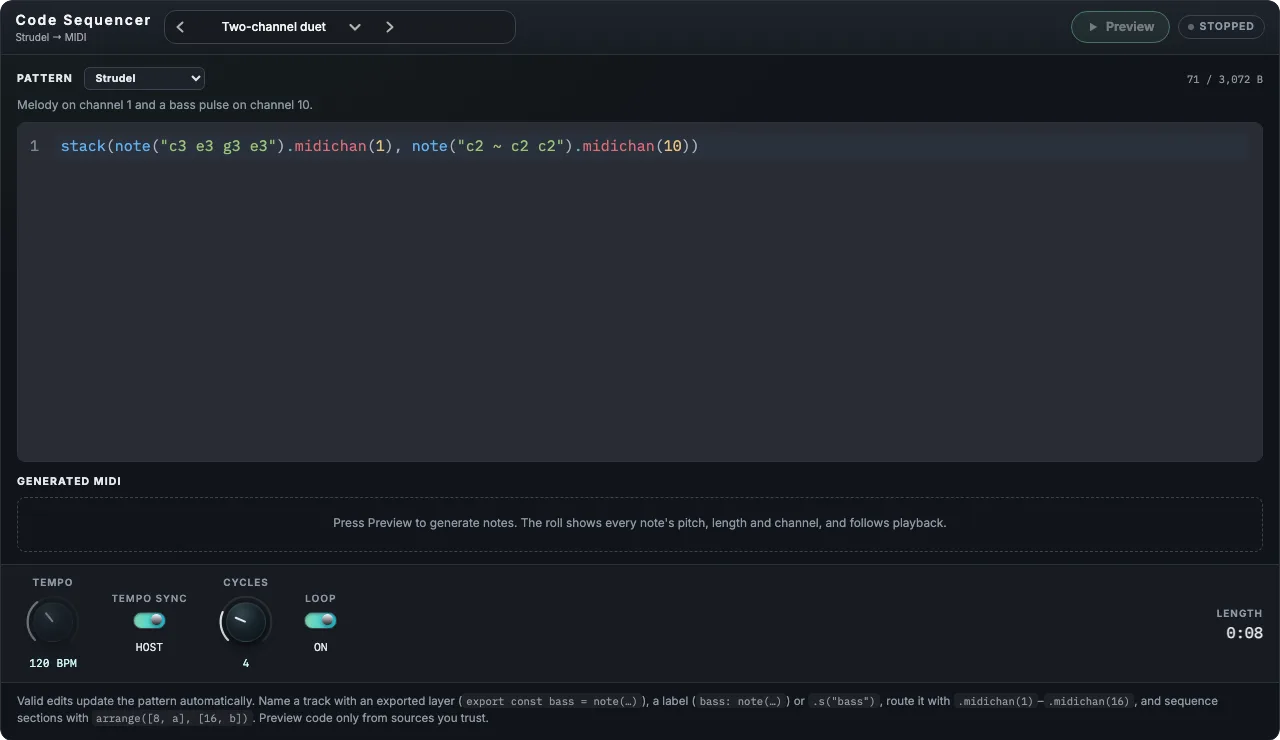
Write music in Symbolic Cycle and hear it as MIDI, with Strudel available as an alternative.
Send each MIDI channel to its own instrument.
Each input channel selects output 1–16, or Off. Connect the chosen output to an instrument's MIDI input. The module routes notes and preserves their channel identity.
The canonical Processor owns routing and held-note destinations. It routes note events; sustain, program changes, pitch bend and MPE need separate support.
Want the control details?
See every parameter and its technical path.
A rack is a fixed rig: several modules already wired together, playable as one instrument. This module is one of the pieces.
Hand Chord routes left-hand chords to an Airy Pad and right-hand strums to an OSC Mini lead.
Experimental
4 modules · hand-chord → midi-channel-router → fm-keys → osc-mini
Code Sequencer routes a Euclidean drum loop to the bundled Pocket Kit sampler; Metergram displays the signal.
Press Play for a 118 BPM drum loop; click Code Sequencer to edit it.
4 modules · code-sequencer → midi-channel-router → sampler → metergram
One code arrangement routes drums, Wavetable bass, FM keys and OSC Mini lead to separate modules; Metergram shows the drums.
Preview a 32-bar E minor groove at 124 BPM, with a breakdown, build and final lead.
7 modules · code-sequencer → midi-channel-router → sampler → wavetable → fm-keys → osc-mini → metergram
Editable verse and chorus code feeds a drum sampler, OSC Mini bass, FM chords and Wavetable lead through MIDI Channel Router.
Preview a 64-bar A minor song at 120 BPM, starting with an eight-bar chord intro.
7 modules · code-sequencer → midi-channel-router → sampler → osc-mini → fm-keys → wavetable → metergram
Write music in Symbolic Cycle and hear it as MIDI, with Strudel available as an alternative.
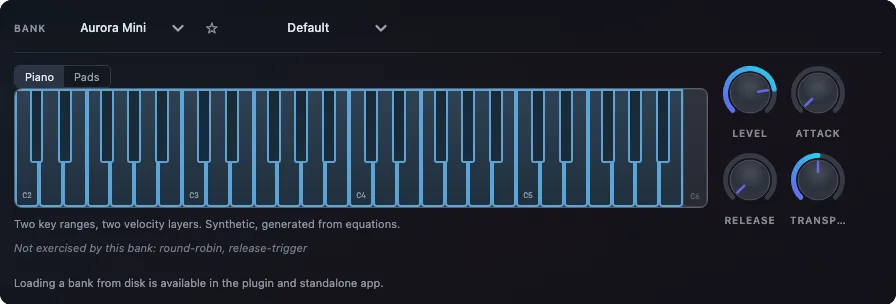
A free instrument for playing layered sample libraries.
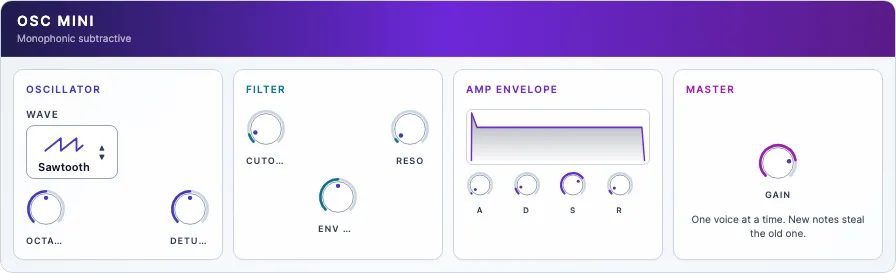
A compact subtractive synth for learning the signal path.