Algorithmic room reverb with bounded feedback.
AvailableEffect
Room Acoustics
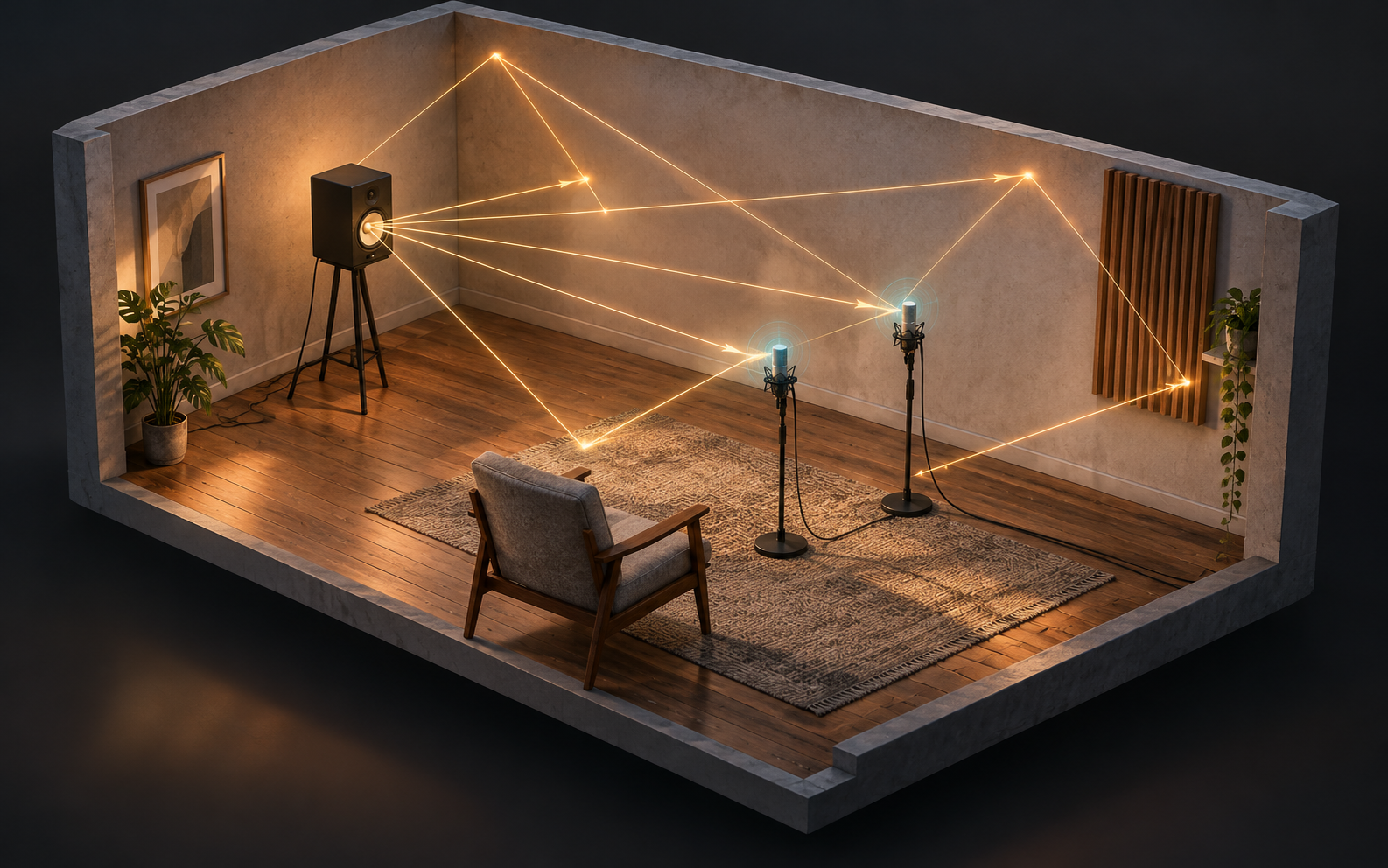
Place a sound in a room. Move the microphones.
About
Shape a room around your recording with source and stereo microphone placement, surface materials, early reflections and a diffuse reverb tail. Explore six rooms and compare measured decay with the acoustic prediction.
How it works.
The stereo input is averaged into one sound source. Image-source early reflections and a seeded ray-traced tail build a separate impulse response for each microphone capsule, then a stereo convolver blends those responses with the original input.
The model supports rectangular shoebox rooms with a three-second response cap. A moved source produces a new snapshot, crossfaded while the previous room keeps playing. Movement has no Doppler effect.
T30 is measured from the completed response; predicted RT60 and a requested target are shown separately. Reflective rooms and higher calculation quality take longer to settle.
What would you make with Room Acoustics?
Describe what you want to make. Build it with the Studio agent.
Goes well with.
The Stargate reverb, ROM tables and all.