
Drive
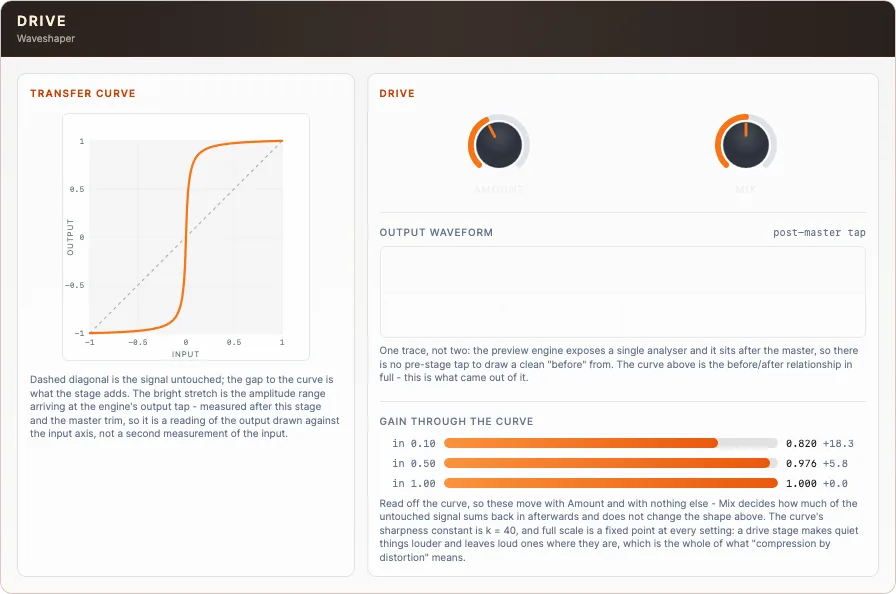
Add harmonics with a waveshaper.
A complete open tape path for printing a signal.
Taper is an algorithmic tape model, not a neural capture. Its character comes from explicit encode and decode conditioning, a nonlinear split-band tape stage, wandering delay taps, bias-dependent slew behaviour, resonant head bump and a protective output clipper.
The browser page runs the same stateful restricted TypeScript functions as the compiler verification lane inside an AudioWorklet. Its nine normalized controls follow the processor signal order. Deterministic random seeds make renders repeatable, state storage follows the engine's float32 realtime convention, and final floating-point dither is omitted because export owns dither in this stack.
Use a dry guitar take for the fastest comparison. Input determines how firmly the signal prints, Shape and Tilt move the spectral weight, Flutter and Bias expose transport wear, and Head Bump adds the low resonance people often identify as tape before they hear the saturation itself.
Start from a named sound, then adjust the instrument to make it yours.
A drawing of the signal flow. Dashed cables carry modulation, not audio.
The input first passes through a complementary high-frequency encode stage. Its level-dependent compression boosts detail before the nonlinear tape split, then the matching decode stage removes the contour after the tape has changed it. Tilt controls the relationship between those two halves rather than acting as a simple shelf EQ.
Flutter writes stereo samples into a circular delay and reads each side from an independently wandering fractional tap. The wander is seeded and deterministic in this port, which makes repeat renders testable while retaining the irregular motion of the original algorithm.
Bias is a bank of slew-history constraints. Below centre it can hold a sample near recent history; above centre it progressively limits fast changes. The stage bypasses at the centre detent, so a neutral comparison does not pay for a hidden approximation.
The tape core splits the signal around Shape, applies different nonlinear laws to the low and high portions, and optionally excites two closely spaced resonant head filters. Decode, output trim and a safety clipper finish the path. The processor holds all history across worklet blocks, which is essential for flutter, resonance, bias and clipping continuity.
Add harmonics with a waveshaper.
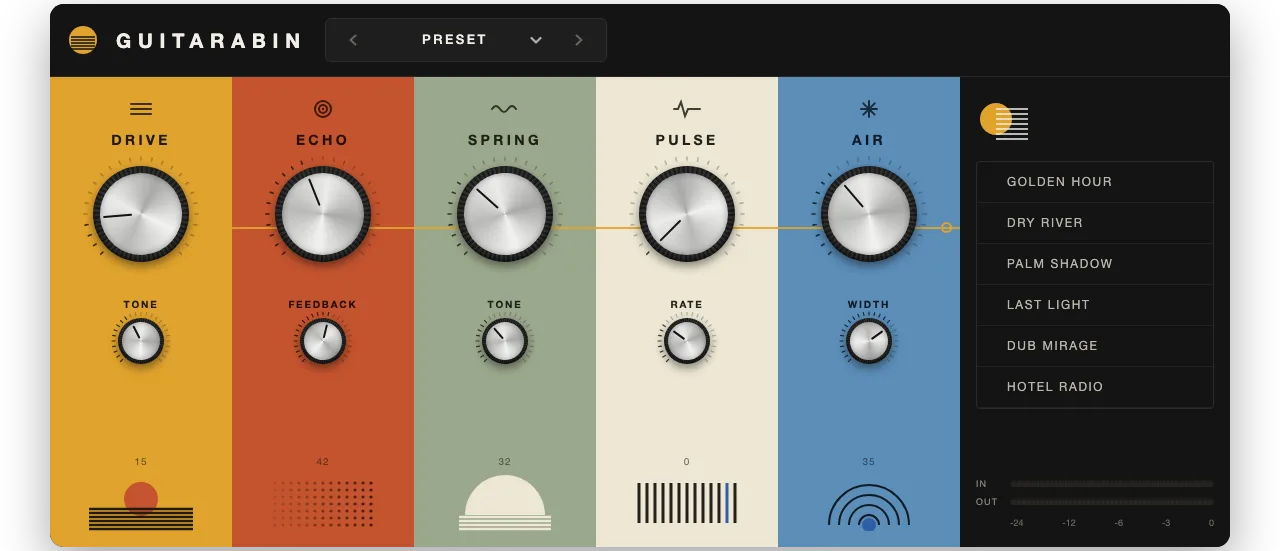
A fixed pedalboard for spacious guitar.
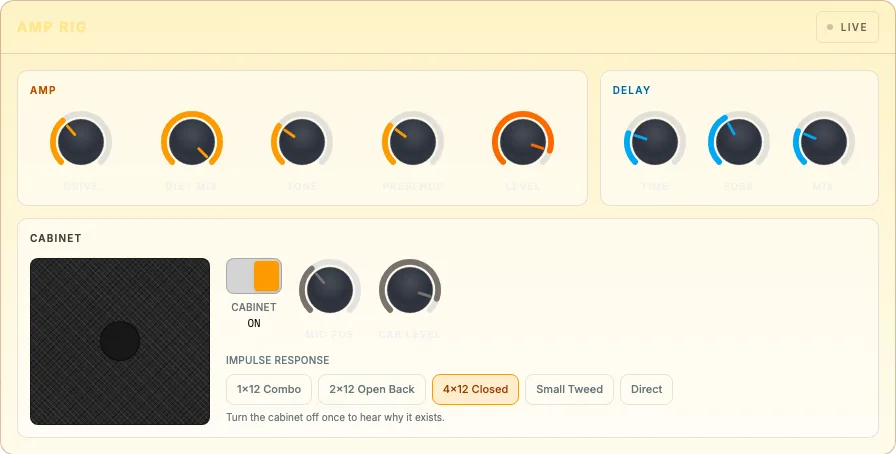
Tube-style drive into a real cabinet.
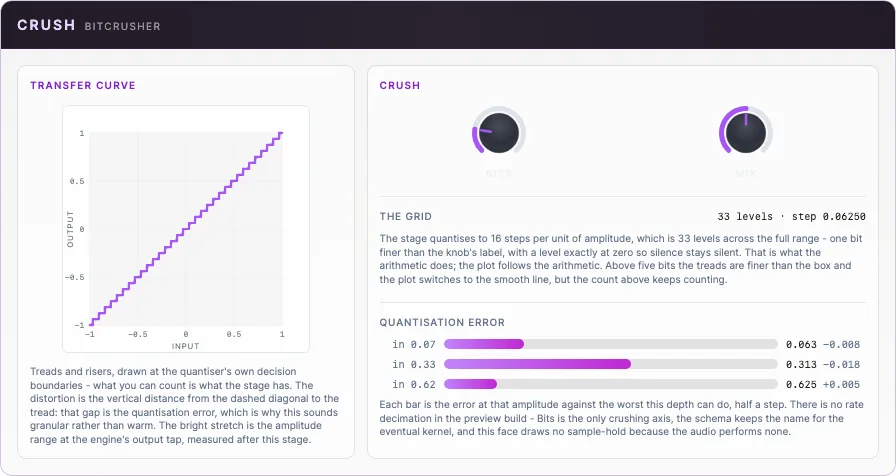
Bit reduction and sample-rate reduction for digital grit.